Kasus herleiten statt auswendig lernen
How many of the prepositions follow from a single principle – and where the honest exceptions are.
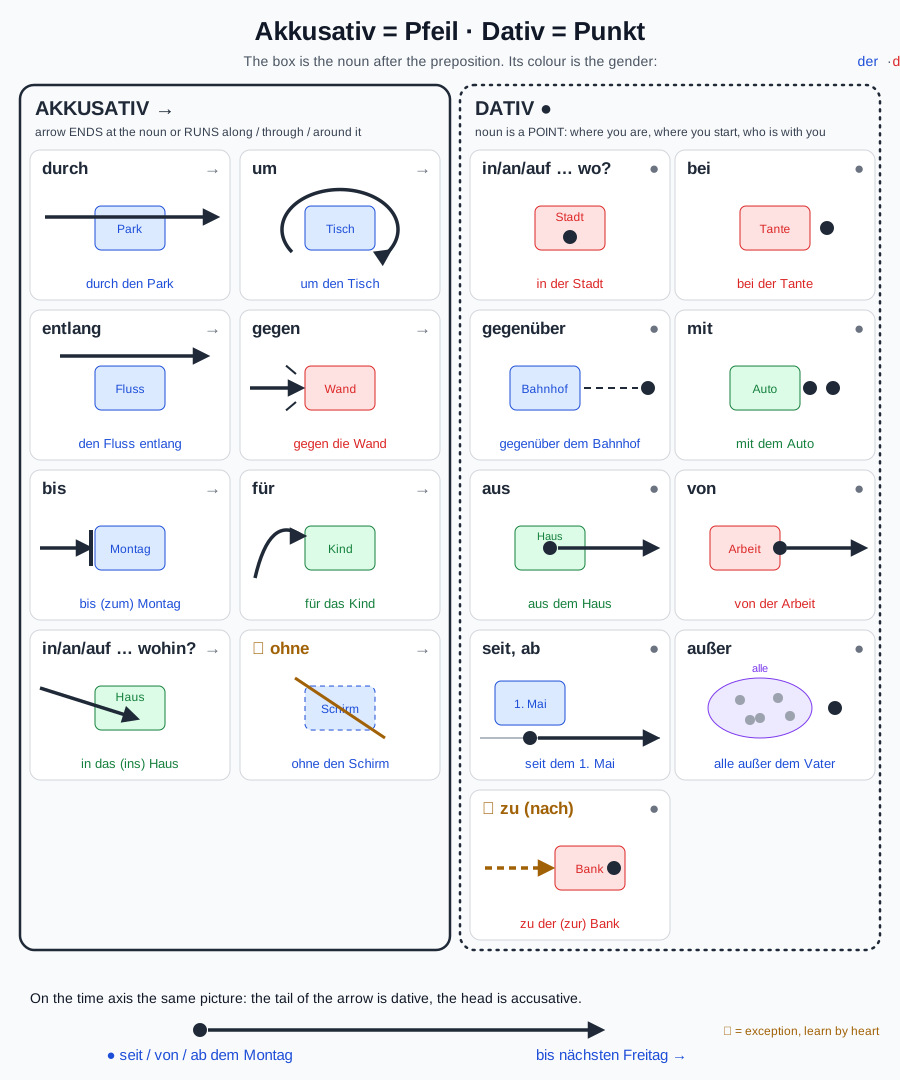
1. The principle
Akkusativ = arrow →
The noun is the place where a movement ends, or the line the movement follows: route, extent, direction, target.
In the language of physics: the noun is the tip of the vector or lies on its path.
Dativ = point ●
The noun is a fixed reference point: where something is, where a movement starts, or who or what is with you.
In the language of physics: the noun is the position, the tail of the vector, or a partner moving along.
Why this is not a made-up rule – the history
Proto-Indo-European had eight cases. The Germanic languages simplified them, and the German Dativ (dative) is a merger of four old cases:
| Old case | Meaning | Survives in German as … |
|---|---|---|
| Locative | where? | bei, gegenüber, in … + wo? |
| Ablative | from where? | aus, von, ab, seit, außer |
| Instrumental | with what? with whom? | mit |
| Dative proper | to whom (recipient) | the bare dative: Ich gebe dem Mann …; zu |
The Akkusativ was always the case of the direct object, the goal of a movement and extent. German still uses the bare accusative for extent: den ganzen Tag arbeiten, einen Kilometer laufen, jeden Morgen.
Latin has exactly the same system – in urbe (abl., in the city) vs. in urbem (acc., into the city). This is the deep structure of Indo-European, not a quirk of German.
Correspondences with Finnish
| Finnish | Deutsch → Akk |
|---|---|
| where to? illative, allative (-Vn, -lle) | ins Kino — to the cinema |
| along what? via what? prolative (-tse), läpi, ympäri | durch den Wald — through the forest |
| Finnish | Deutsch ● Dat |
|---|---|
| where? inessive, adessive (-ssa, -lla) | im Kino — at the cinema |
| from where? elative, ablative (-sta, -lta) | aus dem Haus — from the house |
| with what? with whom? adessive, kanssa | mit dem Zug — by train |
| to whom? allative, when it is about a person | dem Mann geben — to the man |
2. Deriving the prepositions with a fixed case
| Akk → | mental image |
|---|---|
| durch | path through |
| um | path around |
| entlang | path along |
| bis | end point of the arrow →| |
| gegen | arrow hits / points at something |
| für | arrow aimed at a target / beneficiary |
| Dat ● | mental image |
|---|---|
| aus | starting point inside ●→ |
| von | starting point on a surface ●→ |
| ab | starting point (place / time) ●→ |
| seit | starting point in time ●→ up to now |
| bei | position next to |
| gegenüber | position opposite ● · ● |
| mit | partner moving along ●● |
| außer | point outside the group (from aus) |
Pairs that test the principle
- gegen vs. gegenüber: same root. gegen is a direction, gegenüber a fixed position opposite.
- seit … bis: tail and tip of the same time arrow – seit dem Montag ●———→ bis nächsten Freitag. The same holds for the pair von … bis.
- außer is derived from aus (Old High German ūzar from ūz) → a point outside.
- entlang after the noun is pure route: den Fluss entlang.
The honest exceptions
| Word | Problem | Solution |
|---|---|---|
| ⚠ zu | goal of a movement, yet Dat | zu goes with people and institutions (zum Arzt, zur Bank, zu meiner Mutter): the old recipient dative – Finnish -lle with a person (lääkärille). |
| ⚠ nach | goal of a movement, yet Dat | Practically invisible: when it expresses direction, it appears with cities and countries without an article (nach Zürich, nach Finnland, nach Hause). When an article appears, nach means after (nach dem Essen) – a position on the time axis ✓. |
| ⚠ ohne | no arrow, yet Akk | Pure memory: ohne is the opposite of mit, so it takes the opposite case. |
Result: of the 17 common prepositions with a fixed case, 14 follow from the arrow / point image, nach is practically invisible, and only zu and ohne have to be learned by heart.
Genitiv-Präpositionen ◆
wegen, während, trotz, statt, innerhalb, außerhalb … – not derivable (mostly fossilised nouns: statt = "Stätte, place"). It is enough to recognise them; in speech they take the Dativ anyway.
3. Deriving the case in prepositional verbs
With the Dat prepositions (aus, bei, mit, nach, von, zu) and the Akk prepositions (durch, für, gegen, ohne, um) there is nothing to derive. The real choice exists only with two-way prepositions (Wechselpräpositionen) used abstractly – and the image still works in the mental picture:
The mind is directed at a target / moves towards a target →
| warten auf | gaze directed at the bus |
| hoffen, sich freuen auf | directed at the future |
| sich verlassen auf | leaning on something |
| achten, aufpassen auf | attention directed at something |
| antworten, reagieren auf | answer sent to something |
| sich konzentrieren auf | focus directed at something |
| denken, glauben an | thought sent to something |
| sich erinnern an | memory travels back to something |
| sich gewöhnen, anpassen an | movement towards |
| sich wenden an | turning towards |
| sich verlieben in | falling into something |
| geraten in | ending up in a situation |
| übersetzen in | moving over into another language |
| … über something | the mind travels over the topic (route!) |
Located somewhere, standing on, under, in front of ●
| bestehen auf | stands firmly on it |
| basieren, beruhen auf | rests on it |
| arbeiten an | located at the desk |
| teilnehmen an | is part of it, inside it |
| leiden an | the illness is in you |
| sterben an | the cause is located in the body |
| zweifeln an | the doubt is located at a specific point |
| erkennen an | recognised by some feature |
| Interesse an | the interest is located somewhere |
| leiden unter | being under a weight |
| verstehen unter | what lies hidden under the word |
| Angst haben vor | stands in front of the threat |
| warnen, schützen vor | the threat is the source |
| fliehen vor | fleeing from something (tail ●) |
The compact rules that follow
- über abstract → always Akk (route over the topic, like durch).
- auf abstract → Akk, except for three verbs of standing / resting on: bestehen, basieren, beruhen.
- vor and unter abstract → always Dat (positions; with vor the danger is the source – the Finnish elative: suojata jostakin, paeta jostakin).
- in → Akk (moving into a state); sich irren in – the mistake is located in the person.
- an → the arrow / point test: thinking, believing, remembering, adapting = arrow; working, taking part, suffering, dying, doubting = located there.
Checking with Finnish
Translate the verb with the Wechselpräposition into Finnish and listen to the case:
Illative (johonkin) → Akk, almost always:
- uskoa johonkin = glauben an
- luottaa johonkin = sich verlassen auf
- rakastua johonkin = sich verlieben in
- tottua johonkin = sich gewöhnen an
- vastata johonkin = antworten auf
- keskittyä johonkin = sich konzentrieren auf
- joutua johonkin = geraten in
- ⚠ osallistua johonkin = teilnehmen an
- ⚠ kuolla johonkin = sterben an
Elative (jostakin) + vor / unter / an → Dat:
- suojata jostakin = schützen vor
- paeta jostakin = fliehen vor
- kärsiä jostakin = leiden an / unter
4. Which preposition? (partly derivable)
The choice of preposition is the least derivable part, but three tricks cover a fair share.
Take the spatial image literally: ab-hängen von (hang down from something), bestehen aus (consist of something), Angst vor (stand in front of the threat), leiden unter (suffer under a burden), sich kümmern um (wrap care around something), sprechen über (fly over the topic), warten auf (look down the road), sich verlieben in (fall into something).
The prefix echo – the separable prefix often repeats the preposition:
| Verb | Echo |
|---|---|
| aufpassen auf | auf – auf |
| anpassen an | an – an |
| einmischen in, einwilligen in | ein ≈ in |
| abhängen von, abraten von | ab ≈ von (both "away from something") |
Finnish elative ↔ German von is a common pair: riippua jostakin = abhängen von, haaveilla jostakin = träumen von, pitää jostakin = halten von, kertoa jostakin = erzählen von, toipua jostakin = sich erholen von. (Not universal: kiinnostua jostakin = sich interessieren für.)
Everything these tricks do not cover is vocabulary – learn warten auf + Akk as one unit, like a Finnish verb with its own case.