Deutsch
German cases and prepositions for Finnish speakers — derived wherever possible.
Visual code
| What | How it is shown | Example |
|---|---|---|
| Gender of the noun | colour of the article and noun | der Tisch · die Wand · das Haus · die Kinder |
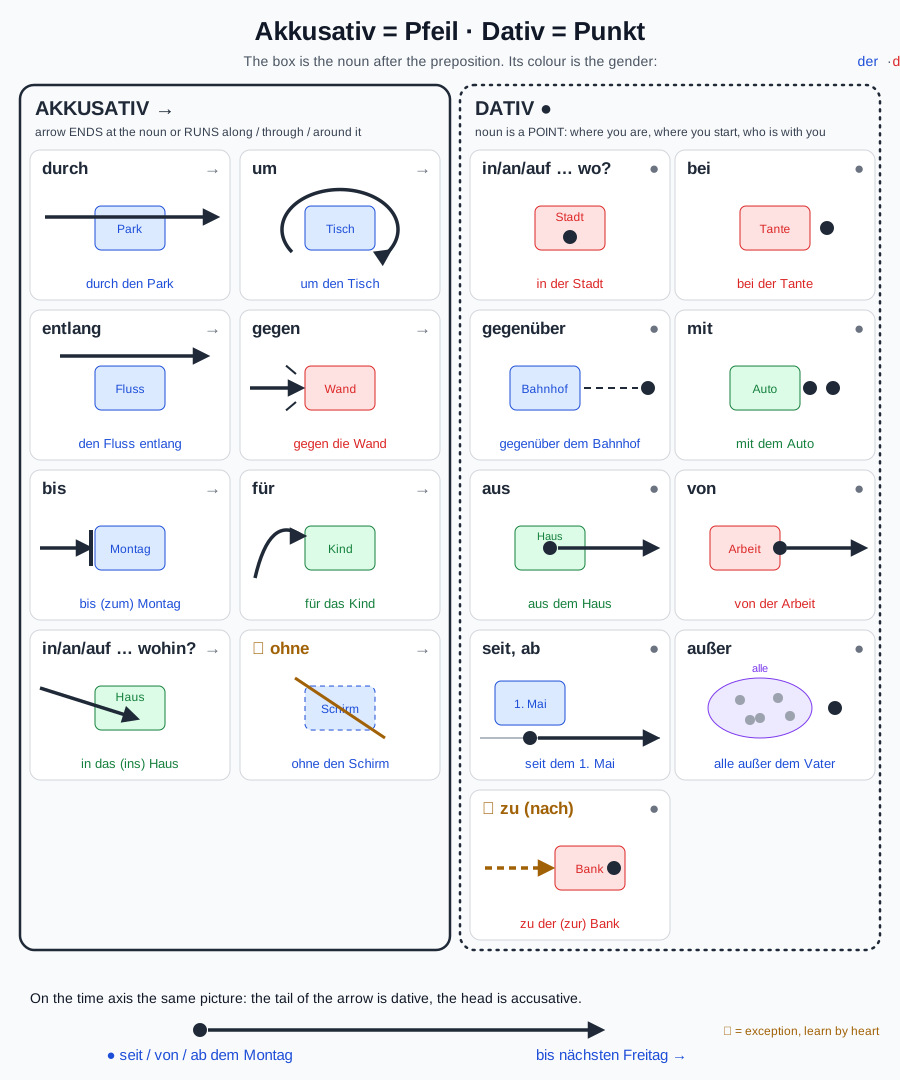
| Preposition takes the accusative | arrow after the preposition | durch den Park |
| Preposition takes the dative | dot after the preposition | mit dem Auto |
| Two-way preposition (Wechselpräposition, Akk or Dat) | both | in |
| Genitive | diamond | wegen |
| Layout | Accusative always in the left column (solid line), dative always on the right (dotted line) | |
| Exception to the rule | ⚠ amber |
Pages
Deriving the cases — start here
Accusative = arrow, dative = dot. The cases are derived from a single picture; includes how they map to the Finnish cases and the few real exceptions.
Prepositions
All prepositions by case, two-way prepositions (wo/wohin), verb pairs, time expressions and contracted forms.
Verbs and their prepositions
About 130 verbs and adjectives with a fixed preposition and case; meaning pairs and da-/wo- compounds.
Articles
Articles and pronouns in all cases — and what really changes in them.
Gender
der, die or das from the ending of the word (-ung, -chen, -um …) and from its meaning, and how reliable each rule is.
Plural
The plural ending (-n, -e, -er, -s, no ending) from the gender and the final letters, umlaut, the dative -n and the closed lists.
Body parts
A diagram of the human body with each part in the colour of its article, plus the words in tables — and the rules that apply here too.
Pronunciation (A1)
Vowel length, ei/eu/ie, ch, s/z/w and stress — the points where a Finnish speaker slips.
Verbs: present, imperative, perfect (A1)
Regular endings, vowel change (e→i, a→ä), sein/haben, separable and modal verbs, the imperative and a first look at the perfect.
Word order, questions, negation (A1)
Verb second, yes/no and W-questions, nicht or kein and where nicht goes.
Nominative, accusative, dative (A1)
The three A1 cases on articles and pronouns, and the possessives mein, dein, sein, ihr.
Numbers and time (A1)
0–100 and beyond, clock times with halb and Viertel, weekdays, months, am/um/im.
Adjectives: endings and comparison (A2)
der alte, ein alter, kalter: the three ending tables and two rules; älter, am ältesten; als and wie.
Suomi
Finnish stems and the genitive, as background to the Finnish exercise. Colour = stem type: vowel stem · stem with strong grade · consonant stem.
Sounds and spelling (äänteet)
How the letters sound, short and long sounds (tuli, tuuli, tulli) and vowel harmony.
Stems (vartalo)
All 14 stem rules from the ending of the basic form to the genitive, with examples and exceptions.
Consonant gradation (astevaihtelu)
The strong and weak pairs (kk/k, t/d, nk/ng …), when the weak grade appears and what never changes.
Case endings (sijat)
Genitive, partitive and the six locative cases with their German equivalents. For reference only.
Verbs: types and present tense (verbityypit)
The six verb types, personal endings, consonant gradation in verbs and negation.
Verb government (verbien rektiot)
Which case a verb requires: tykätä + -sta, soittaa + -lle, odottaa + partitive, plus the infinitives.
The object (objekti)
Partitive, -n or nominative: negation, result, amount, number, imperative and the pronouns minut, sinut.